
Stay ahead of the game

Sign up for our newsletter to receive the latest digital marketing strategies and insights for the month ahead, delivered straight to your inbox!

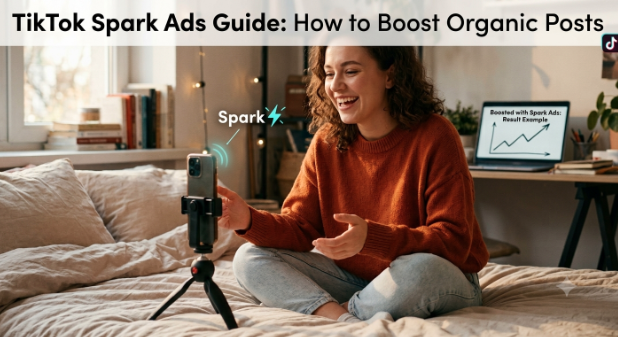
    TikTok Spark Ads Guide: How to Boost Organic Posts

    TikTok Ads

    I’ve audited a lot of TikTok accounts where the ad account looks fine and the results still lag. Same budget as a competitor, same targeting, same objective – worse numbers. Nine times out of ten, the answer isn’t strategy. It’s format. They’re running polished, ad-account-native creative when they should be running TikTok Spark Ads.

    Here’s the number that should reframe how you plan your next TikTok campaign: TikTok Spark Ads convert existing organic posts into paid placements and post an average CPA of $14.62, compared to $23.18 for standard non-Spark formats, based on Nielsen’s analysis of 780 direct-response campaigns across North America and Western Europe. That’s not a small edge. That’s a format doing more than a third of your cost-efficiency work before you’ve touched targeting or bid strategy.

    There’s a reason TikTok Spark Ads work, and it’s not a TikTok-specific trick. Robert Cialdini, the psychologist who literally wrote the book on persuasion, put it simply: “We like people who are similar to us.” A Spark Ad keeps the original creator’s handle, their existing comments, their like count – all the social proof a brand-account ad can never fake. The ad doesn’t look like an ad. It looks like something your audience already decided was worth watching.

    In this guide, I’ll walk through what TikTok Spark Ads actually are, why the performance gap over in-feed ads is so consistent across categories, exactly how to set one up, and the mistakes that quietly cost advertisers their CTR advantage.

    Table of Contents

    What Are TikTok Spark Ads?

    A TikTok Spark Ad takes an existing organic post – either your brand’s own video or a creator’s video you’ve been authorized to use – and runs paid distribution behind it. Unlike a standard in-feed ad, which is built fresh inside Ads Manager and appears from your ad account with zero history, TikTok Spark Ads appear exactly as the post did organically. Same profile, same caption, same comment section, same like count.

    That distinction matters more than it sounds. Regular in-feed ads give you full creative control, but they carry no social proof. TikTok Spark Ads arrive pre-loaded with it. Viewers see a video that already has thousands of comments and shares before your ad spend touches it, and that visible engagement does real persuasive work TikTok’s algorithm can’t manufacture on its own.

    TikTok Spark Ads support TikTok’s core paid formats, including In-Feed placements, TopView, and Smart+ campaigns, which means you’re not sacrificing targeting sophistication to get the organic-native look. You can layer standard audience targeting, bidding strategies, and campaign objectives directly on top of a boosted organic post.

    The mechanism requires one extra step non-Spark ads don’t: authorization. If you’re boosting your own brand’s post, you generate a Video/Post Code directly inside TikTok’s Creative Center. If you’re boosting a creator’s post, the creator has to grant you authorization first – either through a direct authorization link or via TikTok’s Business Center permissions system. TikTok’s official Spark Ads documentation walks through every authorization option in detail.

    TikTok Spark Ads

    Why TikTok Spark Ads Outperform Standard In-Feed Ads

    The performance gap between TikTok Spark Ads and regular in-feed ads isn’t a rounding error, and it holds up across multiple independent data sources. TikTok Spark Ads deliver an average CTR of 7.21% with a CPC as low as $0.89 – the strongest cost-efficiency numbers of any major TikTok ad format tracked in 2026 benchmark reports.

    Completion rate tells the same story. TikTok Spark Ads achieve roughly 142% higher video completion rates than standard in-feed ads, largely because the format feels native to the platform instead of interruptive. Viewers don’t subconsciously categorize it as “an ad to skip.” They categorize it as “a video with a lot of comments,” and that reclassification changes how long they stay.

    This isn’t uniform luck. It’s category-dependent, and the differences are worth planning around. Beauty and skincare brands see the strongest TikTok Spark Ads ROAS at an average of 4.8x, followed by food and beverage at 4.1x, health and supplements at 3.6x, fashion at 3.2x, and home and lifestyle at 2.9x. If your category sits in that top tier, TikTok Spark Ads shouldn’t be a test. They should be your default format.

    Adoption data backs up that shift already happening at scale: 62% of UK TikTok advertisers now use TikTok Spark Ads as their primary format, up from just 34% in 2024, according to platform-usage tracking. The advertisers who haven’t made that switch yet are, on average, paying more per result than the ones who have.

    How to Set Up a TikTok Spark Ads Campaign

    Setting up TikTok Spark Ads takes a few more steps than a standard in-feed ad, but none of them are complicated. Here’s the exact sequence:

    Step 1: Choose your source post. Decide whether you’re boosting your own brand’s organic content or a creator’s post. If it’s a creator’s video, confirm you have a real, ongoing relationship – not a one-off DM asking to “use” their content.

    Step 2: Get authorization.

    • For your own brand posts: open TikTok Creative Center, locate the video, and generate a Video/Post Code. This code is what links the TikTok Spark Ad to the original organic post.
    • For creator posts: the creator authorizes you either through a direct link they generate in their TikTok app settings, or through TikTok Business Center if you’re managing the relationship at scale.

    Step 3: Build the campaign in Ads Manager. Create a new campaign, choose your objective (Traffic, Conversions, App Installs, etc.), and at the ad level, select “Use TikTok post” instead of uploading new creative. Paste in the authorization code or Video/Post Code from Step 2.

    Step 4: Layer your targeting. Everything you’d normally configure – audience, placement, bid strategy, budget – applies exactly the same way it would to a standard in-feed ad. The TikTok Spark Ads mechanic only changes the creative source, not the campaign structure around it.

    Step 5: Launch and monitor separately from the organic post’s own metrics. The TikTok Spark Ads paid performance (CTR, CPA, conversions) shows up in Ads Manager. The post’s organic engagement continues showing on the original video. Track both, since a strong organic post can quietly justify more paid budget behind it. For a deeper look at how TikTok fits into a full paid media setup, see Adcore’s TikTok advertising guide.

    Common TikTok Spark Ads Mistakes to Avoid

    Boosting a post with a weak organic signal. TikTok Spark Ads amplify whatever’s already there – comments, shares, completion rate. Boost a post nobody engaged with and you’re paying to amplify mediocrity, not authenticity. Only promote posts that already proved themselves organically.

    Skipping creator authorization paperwork. Informal verbal agreements don’t hold up if a creator disputes the usage later, and TikTok can pull a Spark Ad that lacks proper authorization mid-flight, killing momentum on a campaign that was working. Always get authorization through TikTok’s official flow, not a screenshot of a text message.

    Treating TikTok Spark Ads as “set and forget” because the creative already exists. The creative might be done, but targeting, bidding, and budget pacing still need active management. A great organic post with sloppy campaign settings underneath it still underperforms.

    Ignoring category benchmarks when setting ROAS expectations. A fashion brand expecting beauty-category 4.8x ROAS from TikTok Spark Ads is setting itself up for a “failed test” that was actually a mismatched expectation. Benchmark against your own category, not the best-performing one.

    Only ever boosting brand-owned content. Creator-sourced TikTok Spark Ads typically carry stronger social proof than brand-account posts, since audiences trust a creator’s account more than a brand’s. If your TikTok Spark Ads strategy never includes creator partnerships, you’re leaving the format’s strongest lever untouched.

    Pro Tip – Choosing Which Posts to Boost

    Don’t start your TikTok Spark Ads strategy by asking “what should we film for ads.” Start by asking “what already worked organically, without us pushing it.” That reframe alone solves most of the guesswork.

    Pull your organic TikTok analytics and rank posts by completion rate and comment-to-view ratio, not just raw view count. A video with 50,000 views and a 9% completion rate is a stronger TikTok Spark Ads candidate than one with 200,000 views and a 2% completion rate, because completion rate is the exact signal TikTok’s delivery algorithm rewards when you attach a paid budget behind it.

    If you work with creators, build the authorization step into your standard contract template from day one instead of chasing it after a post already performs well. The best-performing organic posts often go viral fast, and negotiating usage rights after the fact costs you the exact window when boosting it would matter most.

    For brands running TikTok alongside other channels, this is also where a genuinely full-service setup pays off: an Adcore Elite Agency engagement means the same team tracking your organic TikTok performance is the one deciding what to boost and how much paid budget to put behind your TikTok Spark Ads, instead of a separate social team handing off a spreadsheet once a month.

    TikTok Spark Ads work because they don’t ask viewers to trust an ad account. They let viewers trust what other people already trusted first. That’s the entire mechanic, and it shows up in every benchmark that matters: lower CPA, higher completion rate, and category-leading ROAS wherever brands actually commit to TikTok Spark Ads instead of treating the format as a side test.

    If you’re still running TikTok primarily through standard in-feed creative, the fastest improvement available to you right now probably isn’t a new targeting strategy. It’s pulling your best-performing organic post from last month and putting paid budget behind it as a TikTok Spark Ad.

      Get exclusive CMO tips that I only share with email subscribers.

      Share this article
      Back to top