Stay ahead of the game

Sign up for our newsletter to receive the latest digital marketing strategies and insights for the month ahead, delivered straight to your inbox!

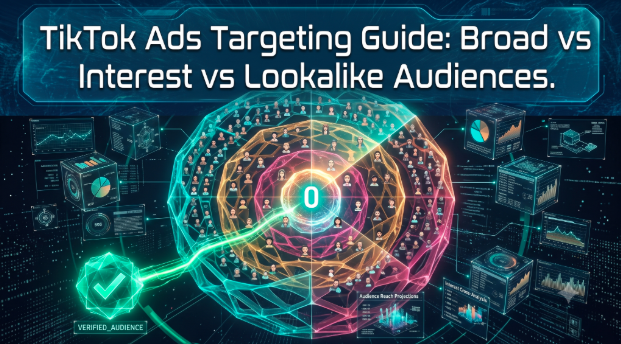
    TikTok Ads Targeting Guide: Broad vs Interest vs Lookalike

    TikTok Ads

    There’s a belief so common in advertising that almost nobody questions it anymore: the more precisely you target, the better your ads perform. It sounds like common sense. It’s also, when it comes to TikTok ads targeting specifically, frequently wrong – and the reason has less to do with the platform than with how the human mind handles incomplete information.

    Daniel Kahneman spent a career studying exactly this failure mode. His shorthand for it: “What you see is all there is.” When a marketer builds a narrow TikTok ads targeting audience, they’re working from the customer persona they can picture – the segments their intuition already knows. What they can’t see is the far larger pool of people the algorithm would have found on its own – converters who don’t fit the persona anyone bothered to imagine.

    TikTok’s own official best practices data backs this up in a specific, measurable way: TikTok ads targeting campaigns reaching over 80% of potential users in a target country achieve 15% lower CPA and 20% higher conversion rates on average, compared to narrower audiences. That’s not an argument against TikTok ads targeting altogether. It’s an argument for knowing exactly which targeting method earns its narrowness, and which one is just a comfortable story standing in for evidence.

    This guide compares TikTok’s three core TikTok ads targeting approaches – broad, interest/behavior, and lookalike – and exactly when each one actually wins.

    Table of Contents

    Broad TikTok Ads Targeting – What It Is and When It Actually Wins

    Broad TikTok ads targeting means setting only demographic guardrails – age, gender, location, language – and letting TikTok’s algorithm handle everything else. No interests. No behaviors. No custom exclusions layered on top.

    It sounds like giving up control over your TikTok ads targeting, and in a narrow sense it is. But TikTok’s algorithm was built to find converters through behavioral signal, not through categories a human decided in advance sound relevant. The wider the pool it can search, the faster it finds people who actually convert – rather than people who merely match a persona on paper.

    This is genuinely counterintuitive if you’ve run Google or Meta campaigns for years, where narrower targeting is often rewarded. With TikTok ads targeting specifically, broad frequently outperforms narrow because the platform’s recommendation engine is doing real-time behavioral matching that most manual TikTok ads targeting simply can’t replicate by hand.

    When broad TikTok ads targeting wins: Early-stage testing, when you have limited historical conversion data and need the algorithm to explore. Products with wide appeal rather than a narrow niche. Accounts still building pixel data, since broad TikTok ads targeting generates the conversion volume needed to exit the learning phase faster.

    When broad TikTok ads targeting doesn’t win: B2B campaigns with genuinely narrow buyer profiles, where the algorithm has no meaningful behavioral signal to search against because your actual buyer pool is small to begin with.

    TikTok ads targeting

    Interest & Behavior TikTok Ads Targeting – What It Is and When It Actually Wins

    Interest-based TikTok ads targeting layers content categories (what people watch and engage with) on top of demographics. Behavior TikTok ads targeting goes a layer deeper – targeting based on actions like recent purchases, app usage patterns, or specific engagement history.

    The distinction between the two matters more than most advertisers realize: interest TikTok ads targeting describes what someone consumes, while behavior TikTok ads targeting describes what someone actually does. A behavior signal (recently purchased a competing product category) is typically a stronger buying signal than an interest signal (watches cooking videos), even though both get lumped under “interest targeting” casually.

    When interest/behavior TikTok ads targeting wins: Once you have enough historical performance data to know which specific categories or behaviors correlate with your actual buyers – rather than which ones sound plausible. Mid-funnel campaigns where you’re narrowing from a broad prospecting pool toward higher-intent segments you’ve already validated with data.

    Where most advertisers get TikTok ads targeting wrong: Building interest targeting from assumption instead of evidence. “Our customers probably like fitness content” is a guess dressed up as a TikTok ads targeting strategy. The far stronger version of this same tactic: pull the actual top-converting audience segments from a broad campaign’s performance data first, then build interest TikTok ads targeting around what the data already showed you – not what seemed intuitive on day one.

    Lookalike TikTok Ads Targeting – The Source-Size Rule Most Advertisers Miss

    Lookalike TikTok ads targeting finds new users who share characteristics with an existing custom audience you upload or build – your customer list, pixel-based purchasers, or engagement audiences from your organic content.

    TikTok requires a minimum source audience of 1,000 users to generate a lookalike at all, but the practical threshold for genuinely useful lookalike TikTok ads targeting match quality is considerably higher. You’ll choose a similarity setting – typically labeled Narrow (roughly 1-3% of the country’s population, highest similarity to your source), Balanced (3-5%), or Broad (5-10%, lowest similarity, maximum reach).

    Here’s the rule most advertisers never check before building lookalike TikTok ads targeting: lookalikes rarely outperform interest targeting unless your seed audience exceeds roughly 50,000 users. Build a lookalike from a source audience of 2,000 recent purchasers, and you may well get a worse-performing TikTok ads targeting audience than a well-built interest segment – simply because TikTok doesn’t have enough source signal to find a meaningfully similar population. Quality and size of the source both matter, but size is the constraint people skip checking first.

    Practical approach to lookalike TikTok ads targeting: Build your source audience from your highest-value customers specifically – not your entire customer list indiscriminately – buyers with 2+ orders, or those in your top 25% by order value. Start with a Narrow lookalike for cold prospecting, and only expand to Balanced once performance on the Narrow TikTok ads targeting audience shows real fatigue (a sustained CTR decline of 20%+ week-over-week is a reasonable signal to expand).

    Custom Audiences – The Highest-Intent TikTok Ads Targeting Option You’re Probably Underusing

    Custom audiences sit underneath both interest targeting and lookalikes, and deserve their own attention since they’re the highest-intent TikTok ads targeting option available – built from people who have already interacted with your brand directly.

    Common custom TikTok ads targeting audience sources include website visitors (segmented by page, not just “all visitors”), cart abandoners, past purchasers, TikTok profile visitors, and video viewers segmented by watch-time threshold (25%, 50%, 75%, 100% completion). Each of these represents a meaningfully different intent level within your TikTok ads targeting setup, and treating them identically wastes the entire point of building a custom audience in the first place.

    Uploaded customer file audiences (CRM data matched against TikTok’s user base) typically see match rates between 30% and 70% in TikTok ads targeting, depending on list quality and how much identifying information you’re able to provide. A clean list of closed-won customers consistently outperforms a larger list of low-intent leads as a TikTok ads targeting source, even when the larger list would generate a bigger reach number on paper.

    Also worth building deliberately inside your TikTok ads targeting setup: exclusion audiences. Removing existing customers from prospecting campaigns, and excluding recent purchasers from retargeting campaigns for the same product, both prevent wasted spend on people who’ve already converted. This is one of the simplest, most overlooked levers in the entire TikTok ads targeting toolkit.

    Building accurate custom audiences depends entirely on your pixel actually capturing the events you’re segmenting by. If your custom TikTok ads targeting audience sizes look smaller than expected, that’s frequently a signal your TikTok Pixel setup isn’t capturing the full picture – not that your audience is genuinely that small. Our TikTok Pixel setup guide covers installation and verification in detail.

    Common TikTok Ads Targeting Mistakes and the Pro Tip That Fixes Them

    Starting narrow because it feels safer. Tight TikTok ads targeting feels like control. It’s usually just a smaller, slower-learning version of the same campaign, starved of the volume the algorithm needs to find real converters.

    Building a lookalike TikTok ads targeting audience from a source under 10,000, expecting interest-targeting-level performance. Check your source size before you build, not after performance disappoints.

    Treating all custom TikTok ads targeting sources as equally high-intent. A video viewer at 25% completion and a cart abandoner are not the same person, and shouldn’t receive the same creative or the same bid strategy inside your TikTok ads targeting setup.

    Never building exclusion audiences into your TikTok ads targeting. If your prospecting campaigns aren’t excluding existing customers, you’re paying full prospecting cost to reach people who already bought.

    Pro tip: run a genuine three-way test before committing budget to one TikTok ads targeting method. Launch broad, interest, and lookalike (built from a properly sized source) simultaneously – each in its own ad group with identical creative – and let each run long enough to clear the learning phase before comparing. If one ad group looks like it’s underdelivering entirely rather than simply underperforming on your TikTok ads targeting test, that’s a delivery problem, not a targeting problem. Our guide on TikTok ads not spending covers how to tell the difference before you draw the wrong conclusion from the test.

    For brands managing TikTok ads targeting strategy and audience testing across TikTok alongside Google and Meta, keeping that testing cadence consistent across platforms – rather than reinventing the approach for each one – is exactly the kind of ongoing campaign management Adcore’s paid media team is built to handle. TikTok’s own audience targeting best practices guide is also worth bookmarking alongside this one for platform-specific updates as TikTok ads targeting options evolve.

    None of TikTok’s three TikTok ads targeting methods is universally correct, and the advertisers who do best on the platform aren’t the ones who picked the “right” one once. They’re the ones who tested broad, interest, and lookalike TikTok ads targeting against real data, checked their lookalike source size before blaming the method, and kept exclusion audiences clean enough that they weren’t paying to re-convince existing customers.

    The instinct to narrow your TikTok ads targeting because it feels more precise is exactly the instinct worth questioning first. What you can picture about your customer is rarely the whole picture – and TikTok’s algorithm, given room through broad TikTok ads targeting, is very good at finding the rest of it.

      Get exclusive CMO tips that I only share with email subscribers.

      Share this article
      Back to top