What is ELM? or Elaboration Likelihood Model
The Elaboration Likelihood Model (ELM) is a theory of persuasion that explains how people make decisions and form attitudes. Developed by Richard Petty and John Cacioppo in the 1980s, the ELM proposes two routes to persuasion: the central route and the peripheral route.
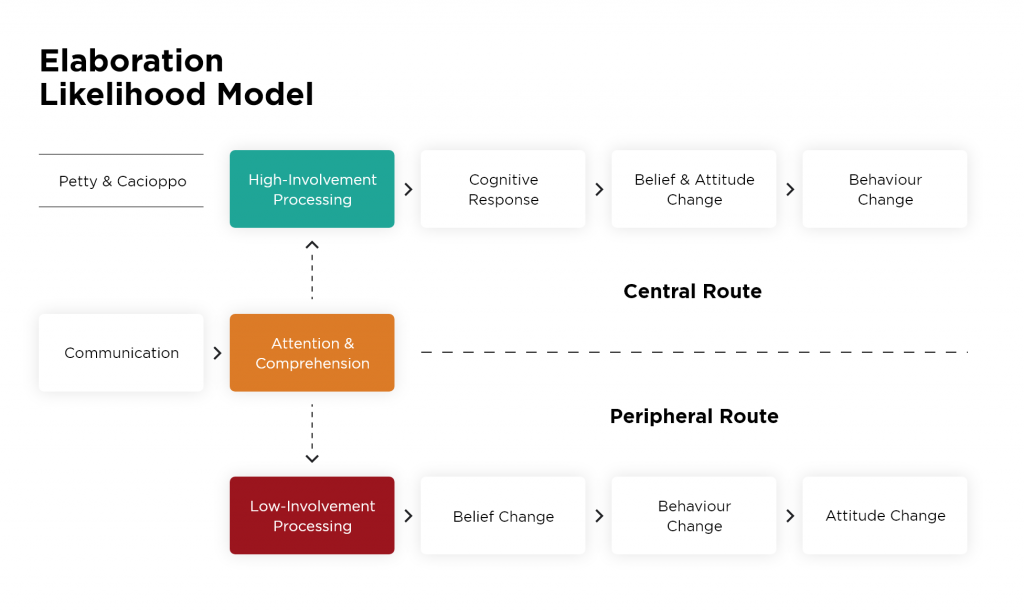
ELM is a psychological framework that can help companies understand how consumers process and respond to marketing messages. According to this model, the process of persuasion begins as soon as the consumer perceives the communication that is transmitted to him.
Involvement Channels
Upon receiving the message, the consumer begins processing it. This processing can be done with high involvement (when the topic is seen as very relevant to him personally) or with low involvement.
The Rational Channel
According to the model, the Rational Channel is the degree of involvement of the consumer that determines the “channel” through which the persuasion process takes place. The central route to persuasion is activated when the degree of consumer involvement is high. This channel can be called the “rational” channel, the one that focuses on the message itself, the arguments, the quality of the arguments, or in short, the “meat”.
When consumers target this channel of persuasion, they are focused on the message conveyed to them, examine it, compare it to their existing attitudes, and produce cognitive reactions – thoughts that support or oppose the message. The more responses that support the message, the greater the chance of persuasion.
When the stage of influencing beliefs is successful, it is more likely to affect the next element of the process – attitudes. The materials used by the involved consumer, who is in the central channel for persuasion, are also “central”: ideas, arguments, supporting data, facts, and everything that can improve the “quality” of the message.
The Peripheral Channel
When the consumer’s involvement in the issue is low, the channel of persuasion to be used will be the peripheral (marginal) channel. In this situation, there will be almost no cognitive (or intellectual) reactions, because the consumer does not pay attention to examining the message itself. Instead, they are content with “peripheral clues”, in everything around the subject itself – who the speaker is, how attractive they are, what they look like, etc.
In a low-involvement situation, there is indeed a chance of having some effect on the consumer’s beliefs, for example, regarding this or that attribute or achievement of one of the candidates. But it is hardly likely that his basic attitudes and feelings will change or be affected, which is certainly true of his actual behavior as well.









 Back to top