

Stay ahead of the game

Sign up for our newsletter to receive the latest digital marketing strategies and insights for the month ahead, delivered straight to your inbox!

    Signs You Need Affiliate Revenue Diversification

    Ad Platforms

    Most affiliate and media businesses I talk to are proud of one number: how much of their revenue comes from a single, well-optimized channel. I get it – concentration used to be a strength. You go deep on one traffic source, one network, one payout model, and you compound. In 2026, that same number is the first thing I ask about, because it is usually the size of the hole in their P&L.

    Here is the stat that should worry anyone still running a single-stream affiliate business: US affiliate spend is projected to hit $13.81 billion in 2026, up 11.3% year over year, according to eMarketer – and almost none of that growth is going to the businesses that look like they did in 2023. It is going to creators, to AI-matched partnerships, and to the top slice of operators who already diversified. Everyone else is fighting over a shrinking share of a growing pie, which is a strange and dangerous place to be.

    There is a name for what happens next if you do not act: concentration risk, the same principle that tells a fund manager never to hold one stock. A media or affiliate business with one traffic source, one network relationship, and one payout model is not a business with high margins. It is a business with one point of failure, dressed up as a business with high margins.

    Below are the 10 clearest signs that affiliate revenue diversification is no longer optional for your business, in the order I would worry about them, and what actually fixes each one without you hiring a full team to do it.

    Table of Contents

    What affiliate revenue diversification actually means

    Affiliate revenue diversification is the deliberate act of adding a second, uncorrelated income stream to a business that currently earns its money one way – usually commission on traffic it drives to someone else’s offer. It is not “get more affiliates” or “join another network.” Those moves add volume to the same risk profile. Real diversification means the new revenue line does not fall when the old one does.

    For a media or affiliate business, that almost always means moving from pure commission to some mix of managed service, resale margin, or platform-partner economics – the same three levers that agencies have used for years, now available to publishers and traffic owners at scale.

    The businesses already doing this are not hypothetical. INMA’s research into publisher revenue models found that 68% of publishers now generate the majority of their ad revenue from direct sales rather than programmatic or affiliate alone, and that performance/affiliate revenue at People Inc. grew 17% to $101 million specifically because it sat alongside other lines, not in place of them. Diversification did not cannibalize their affiliate business. It protected it.

    one

    1. Your best month is one algorithm update away from your worst

    If your traffic comes from search, you already know this pain, but the numbers are worse than most people admit out loud. Wirecutter, one of the most established affiliate publishers in the world, saw its Google search visibility drop 60% between May and August 2025, per eMarketer’s 2026 research. Close to 70% of publishers told the same researchers they expect Google’s changes to keep hurting affiliate businesses specifically.

    That is not a niche problem. It is what happens when your entire revenue model depends on a distribution layer you have zero contractual control over. A platform update, a policy change, or a ranking shift can cut your traffic in half on a Tuesday, and there is no account manager to call.

    The tell: if one traffic source or one platform accounts for more than 50% of your revenue, you are not running a business. You are running someone else’s algorithm on commission.

    2. You’re not a super-affiliate, and the math is brutal for everyone else

    Affiliate revenue is savagely concentrated at the top. Industry data from Track360’s 2026 report shows the top 10% of affiliates drive 67% of total program revenue, and enterprise programs run an average of 847 active affiliates while mid-market programs average just 94. Unless you are certain you sit in that top decile, the program-level growth numbers you read in the trade press are not describing your business.

    This is not a reason to work harder inside the same model. It is a reason to stop competing purely on volume against operators with a decade of head start and infrastructure you cannot replicate by Q3. Trying to out-scale a super-affiliate at their own game is a slow way to lose margin.

    The tell: if your growth strategy is “drive more traffic to the same offers,” you are optimizing a model that structurally favors whoever is already biggest.

    3. AI answer engines are replacing the click your revenue depends on

    Shopping-related queries on ChatGPT grew faster than any other query type between December 2024 and June 2025. Consumers are already using AI assistants for price comparison (54%), deal-finding (41%), and review-checking (41%), according to eMarketer’s 2026 affiliate research. For one eyewear brand, nearly 70% of the sites cited in ChatGPT’s mentions came from affiliate content – which sounds like a win, until you notice the click never happened. The answer engine gave the recommendation. Your site gave up the traffic that used to convert.

    This is the same disruption search-first publishers went through with featured snippets, except faster and with a far more confident-sounding intermediary. If your revenue model depends on someone clicking through to your comparison page before they buy, that dependency is getting more fragile every quarter, not less.

    The tell: if your organic click-through rate has been quietly declining for two straight quarters and you have not changed anything on your side, this is why.


    4. Commission rates only move in one direction

    The global average affiliate commission rate sits at 8.3% of attributed revenue, and even that average hides how thin the room to negotiate really is. In iGaming, one of the highest-paying verticals, operators paying below a 25% revenue-share threshold lose 71% of their super-affiliate traffic within 12 months – which tells you how competitive the top of the market already is for the payout percentage that remains. If advertisers are fighting that hard to hold onto their best affiliates, they are not finding new margin to hand you.

    Commission compression is not a one-quarter story. It is the direction the whole model has moved for years, and nothing about AI-driven attribution, rising ad costs, or advertiser margin pressure points the other way.

    The tell: if your effective commission rate today is lower than it was two years ago on the same offers, that is not a fluke. That is the ceiling.

    ffiliate marketing manager

    5. Privacy rules are adding work without adding revenue

    Third-party cookies are on their way out, and what replaces them is not a clean swap. Server-side tracking is expected to reach only 60-65% accuracy by mid-2026, and most systems can reliably connect just 3-5 touchpoints across devices – a real step down from the attribution most affiliate businesses built their reporting on.

    Regulation is stacking on top of that. The EU’s Digital Services Act mandates full affiliate disclosure by January 2026, and Meta is requiring mandatory creator disclosure tags on all affiliate content by March 2026. None of this is optional, and none of it grows your revenue. It is pure compliance overhead sitting directly on top of a model that was already losing attribution accuracy.

    The tell: if your team is spending more hours this quarter on tracking fixes and disclosure updates than on anything that grows revenue, the model itself is the problem, not the execution.


    6. You get paid net-30-to-60 while your costs are due today

    Payment delays of 30 to 60 days remain the industry standard for affiliate payouts in 2026. Meanwhile your traffic costs, your team, and your infrastructure are all due on a much shorter clock. That mismatch is manageable when volume is growing steadily. It becomes dangerous the moment growth slows or a network delays a payment cycle, because you have no faster-paying revenue line to lean on while you wait.

    A business with only one payout structure has only one cash-flow rhythm. If that rhythm ever breaks – a network dispute, a chargeback wave, a slow quarter – there is nothing else in the business moving at a different pace to cover the gap.

    The tell: if a single delayed payout cycle would create a real cash-flow problem, that is a diversification gap, not a collections problem.

    7. Your advertisers keep asking for channels you don’t sell

    If you work with advertisers directly, you have had this conversation: a client asks whether you can also run TikTok, or Microsoft Ads, or a retail media placement, and the honest answer is no. This is the exact same trap that stops digital agencies from growing without hiring – the request does not disappear when you say no. It goes to whoever said yes.

    The instinct is to either hire a specialist for a channel you are not sure will stick, or turn the request down and hope the client does not shop it around. Both options are slow, and both leave money on the table while you decide.

    The tell: if you have turned down a channel request from an existing advertiser in the last quarter, you already know the size of the opportunity you are not capturing.


    8. One revenue stream means one point of failure for the whole business

    Affiliate marketing is a genuinely large and growing channel – 12.4% of total global digital ad spend, on track for $24.7 billion globally in 2026, up 26% year over year. That is exactly why it is dangerous to rely on it exclusively: it means 87.6% of digital ad spend is flowing through models your business has no exposure to at all. You are not under-diversified because affiliate is shrinking. You are under-diversified because everything else is growing around you and you are not participating in any of it.

    Concentration risk is the same principle whether you are looking at a stock portfolio or a revenue model: the danger is never the asset you are holding, it is holding only that asset.

    The tell: if you could not answer “what percentage of the total addressable market are we actually exposed to” with a number above 15%, this is your answer.

    9. You don’t have platform-partner status, so you don’t get the credits that protect your margin

    Ad platforms hand out real money to the businesses that hold direct partner status with them – ad credits, spend-match incentives, priority support – and almost none of it to everyone else. It is the same dynamic covered in how agencies unlock TikTok ad credits: the credits exist, but only for operators who have already cleared the bar of direct platform relationships across enough spend and enough accounts to matter.

    A media or affiliate business with strong traffic and real advertiser relationships usually has none of that platform-partner access, because it was never built to sell managed paid media in the first place. That is a real, measurable margin left on the table every single month, not a hypothetical one.

    The tell: if you have never seen a platform ad credit or spend-match offer applied to your business, it is not because they do not exist. It is because you are not plugged into the layer that distributes them.


    10. Building a second revenue line in-house takes months you don’t have

    Say you decide to fix all of the above the traditional way: hire platform specialists, negotiate your own direct relationships with TikTok, Microsoft Ads, or Criteo, build the billing and reporting infrastructure, and wait for those relationships to mature enough to unlock real incentives. That is not a quarter of work. It is a multi-year build, and every month of it is a month your competitors who skipped the build are already earning from it.

    This is the actual cost of doing it yourself: not the salaries, though those are real too, but the time-to-revenue. A second income stream you launch in 18 months is worth far less than the same stream launched in 30 days, because the market keeps moving while you build.

    The tell: if your plan for diversifying is “hire someone next year,” the businesses that are already diversified did not wait for next year.

    adcore partner program screenshot

    The fix: affiliate revenue diversification without hiring a channel team

    Every sign above points to the same root cause: a single revenue model with no second gear. The fastest way to fix affiliate revenue diversification without a multi-year build is to plug into infrastructure that already exists, rather than building your own.

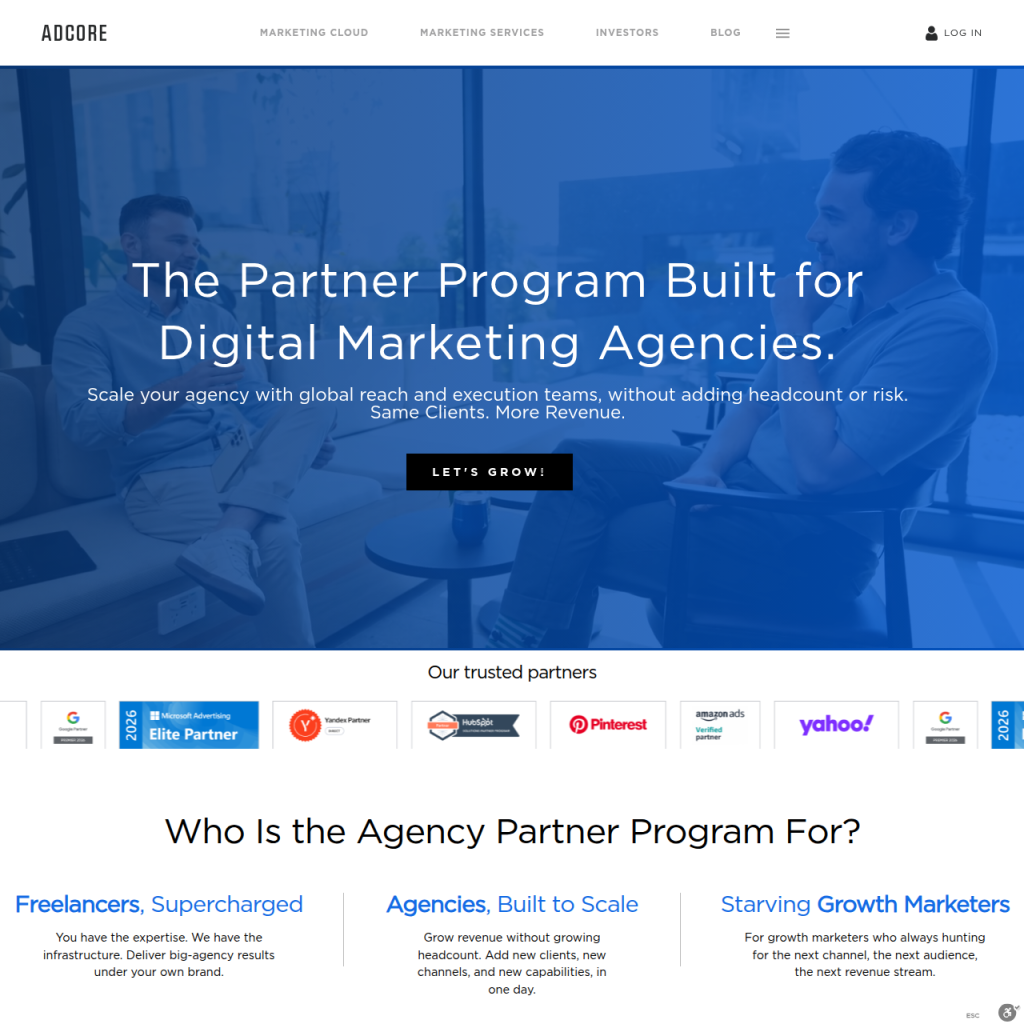
    That is exactly what a channel partner program is for. Adcore’s Channel Partner Program – free to join, no minimum spend, no long-term contract – lets a media or affiliate business add a second revenue line by offering managed paid media execution across TikTok Ads, Microsoft Ads, Google Ads, Criteo, and Meta, under its own brand, to the advertiser relationships it already has. Adcore handles account setup, billing, and campaign execution across 95,000+ ad accounts and $600M+ in managed spend. The partner keeps the client relationship, the branding, and the invoice, and gets access to platform ad credits and performance incentives that come from Adcore’s direct partner status with those platforms – the same access covered in our recent roundup of agency partner programs worth joining.

    For a media company sitting on real traffic and real advertiser trust, that is the second revenue stream this article has been describing all along – live in weeks, not the 18-month build from sign #10.


    None of these 10 signs are a reason to panic, and none of them mean affiliate is dying – the channel is growing 26% year over year. They mean the businesses still running on one revenue stream are about to feel that growth go to everyone except them. Diversifying affiliate revenue is not a multi-year strategic bet anymore. It is a decision you can act on this month.

    If any three of these ten signs sounded familiar, the fastest next step is not a hiring plan. It is joining a channel partner program that already has the platform relationships, the billing infrastructure, and the credits built in.

      Get exclusive CMO tips that I only share with email subscribers.

      Share this article
      Back to top