Stay ahead of the game

Sign up for our newsletter to receive the latest digital marketing strategies and insights for the month ahead, delivered straight to your inbox!

    Why Two Competitors’ ChatGPT Ads Look Exactly Alike

    AdcoreAI

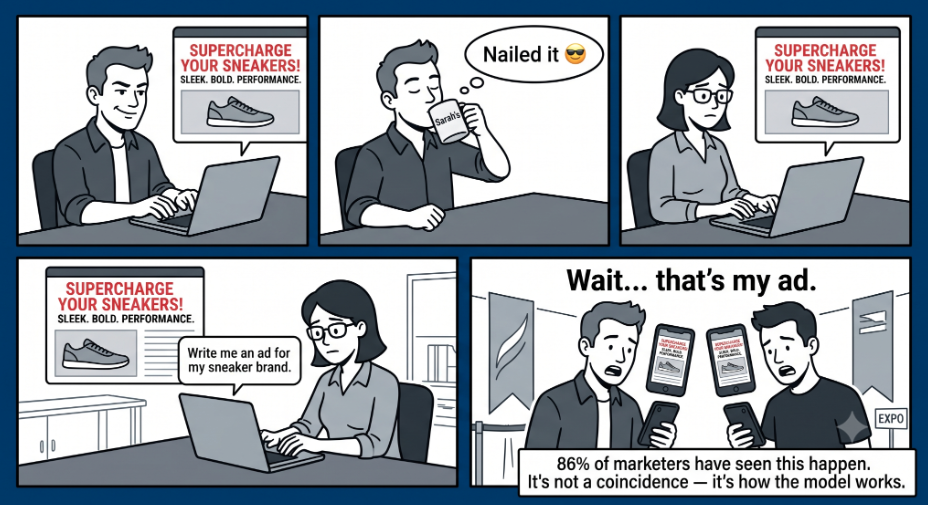
    Ask ChatGPT for an ad. Then ask it again but for your competitor. Congratulations, you’ve just written the same ad twice. Welcome to the world of ChatGPT Ads.

    That’s not a joke, and it’s not an edge case. Here’s a number that should worry anyone relying on ChatGPT for AI ad creatives: 86% of marketers say they’ve seen AI-generated outputs that resemble their competitors’ content, according to Smartly’s 2026 Digital Advertising Trends Report. 

    That’s not a prompting problem. It’s a structural one. General-purpose AI tools like ChatGPT are trained to produce the statistically most probable response to a given prompt, which means when your competitor types a near-identical brief into the same model, they get a near-identical result. Two brands, one tool, one output. I’ve watched this play out in real ad accounts: ChatGPT ads that tests fine on quality but flatlines on performance, because “fine” was never the bar. Distinct was.

    The data on audience reaction backs this up. According to Power Digital’s 2026 social media report, 63% of users say they’re less likely to engage with AI-generated visuals, and nearly half form a negative opinion of a brand that uses visible AI in customer-facing content. People aren’t rejecting AI. They’re rejecting sameness, and generic ChatGPT ads, built to produce exactly that.

    Table of Contents

    The Sameness Problem, By the Numbers

    • The data on generic ChatGPT ads is remarkably consistent across independent studies. Brafton’s 2026 marketing survey found “thin or generic-sounding” content was marketers’ single biggest complaint about AI output, ahead of factual accuracy, SEO performance, and brand voice. Tellingly, the most concerned marketers weren’t beginners. They were the ones with 11+ years of experience, who know what differentiated creative looks like and spot its absence fastest.

      The convergence shows up in output, not just perception. Industry analysis describes AI-generated content getting smoothed toward a statistical median: professionally correct, but indistinguishable from whatever a competitor generated that same morning.

      For ad creative specifically, this is measurable. When two competing brands run similar creative into the same auction, the platform’s own algorithm starts optimizing on price, not distinction, because nothing tells it your offer is meaningfully different from the one three slots down.

    ChatGPT Ads

    Why General AI Converges by Design

    This isn’t a flaw that better prompting fixes. It’s how foundation models are built. Standard foundation models are trained to reflect existing public content, not to challenge conventions or propose new commercial approaches, which means unless you feed the model your own product data, proof points, and customer language, your competitor running a similar prompt through the same general-purpose tool gets a near-identical result.

    There’s a name emerging for this in industry analysis: semantic ablation, the process by which AI-generated language, trained on an ever-growing pool of other AI-generated language, gets pulled progressively toward the statistical center. The unusual phrasing, the specific customer insight, the unexpected angle, all get smoothed away before publication, because the model was optimized to minimize risk, not maximize distinction.

    As The Drum’s creative leadership put it plainly: AI has democratized execution. It has not democratized imagination. That’s the whole argument in one sentence. A chatbot can produce grammatically perfect ad copy in nine seconds. It cannot decide what your brand should stand for, or find the unexpected angle that makes someone stop scrolling, because that decision was never just a language-prediction problem to begin with.

    What Ad Creative Actually Requires

    Ad creative isn’t just “content with a call to action.” It has structural requirements a general chat interface was never designed around.

    Before trusting any tool with your AI ad creative, ask three questions a chatbot can’t answer for itself:

    1. Does it know your platform specs? Meta, Google, and TikTok each enforce different aspect ratios, character limits, and creative-testing frameworks. A general AI tool generates an image or headline with no awareness of any of them.
    2. Does it know what already worked? A general AI tool has no visibility into which of your last twenty ad variants converted, what your CPA benchmark looks like by placement, or which creative angle is fatiguing with your retargeting audience this week.
    3. Does it export anywhere, or just sit in a chat window? It can write you an ad. It has no way to tell you whether that ad is the right one to test next, and no way to get it live without you doing the resizing, exporting, and uploading by hand.

    This is exactly the gap Adcore’s own recent work has had to navigate. In a recent AI video creative campaign for House, Adcore’s Creative Studio didn’t rely on a single AI-generated output. It tested three approaches in parallel: AI-generated video, UGC-style content, and manually edited assets, then measured which one actually drove reach and conversions. That’s performance data feeding creative decisions, not a chatbot generating an asset in isolation.

    ChatGPT vs. Adcore AI Studio

    Put the two side by side and the gap stops being theoretical.

    ChatGPT generates an asset from a prompt, full stop. It doesn’t know your past campaign performance, doesn’t know Meta’s aspect ratio requirements versus TikTok’s, and has no way to publish what it makes. Every output leaves the chat window as a file you still have to resize, review, and upload yourself, with no record of whether the last five variations you tried actually converted.

    Adcore AI Studio was built to close exactly that gap. It’s one platform that generates AI ad creative and exports it straight into your connected ad accounts, so a finished asset can go from brief to live campaign without a manual handoff. It reads your own account history before generating anything new, so what it produces is informed by what has already worked for your brand, not just what’s statistically average across the internet. And because it’s built for ad formats specifically, output arrives already sized and specced for the platform it’s headed to.

    The difference isn’t that one tool is “smarter.” It’s that one was built to write, and the other was built to launch.

    The Real Cost of Getting This Wrong

    When creative converges, the effect isn’t cosmetic. It’s financial. When buyers can’t perceive a meaningful difference between two options, cost becomes the only remaining differentiator, a race that erodes margin for everyone running it.

    The inverse is measurable too. The Drum’s analysis of creative differentiation found that brands investing in genuinely distinctive creative see shorter sales cycles and customers willing to pay a premium, not because the product is objectively better, but because the brand feels irreplaceable. And the gap only widens over time: as more of the open web fills with AI trained on other AI, sameness compounds. Locking into generic AI ad creative now isn’t just losing today’s A/B test. It’s a harder trend to reverse later.

    Use AI That Knows Your Account, Not Just the Internet

    General-purpose AI didn’t fail at AI ad creative because the technology is weak. It failed because it was never built for the job: no visibility into your performance data, no awareness of platform specs, and a training objective that rewards the average over the angle that actually gets someone to stop scrolling.

    The fix isn’t abandoning AI. It’s using a tool built around your own account data instead of a generic prompt box. That’s exactly what Adcore AI Studio is built to do: generate creative informed by what’s already worked, sized correctly for the platform it’s headed to, and exported straight into your ad accounts without a manual handoff.

    If your workflow starts with a blank chat window, you’re not testing whether AI can help your ads perform. You’re testing whether your competitor’s identical prompt beat you to it.

      Get exclusive CMO tips that I only share with email subscribers.

      Share this article
      Back to top